Showing posts with label Wing-back. Show all posts

Javier "Il Trattore" Zanetti

Javier Adelmar Zanetti (born 10 August 1973 in Dock Sud, Buenos Aires Province) is an Argentine footballer who plays for Serie A club Internazionale. Javier Zanetti has played for Inter since 1995, taking the captain's armband in 1999. Known for his versatility, he is adept on both the left and right wing, having played on both flanks as a fullback as well as a winger. He slots into several midfield positions with ease, particularly as a defensive or central midfielder. Internationally, he holds the record of the most capped player in the history of the Argentine national team and has played in the 1996 Olympic tournament and in two World Cups, in 1998 and 2002.

Known as "Pupi" in Argentina, Zanetti was born in Buenos Aires, picking up the nickname "Il Trattore" (The Tractor) soon after his move to Italy where his strength, resilience, stamina, and his ability to run past opposing defenders when joining the attack from his right back position earned him notoriety. More recently, he plays in the right midfield. He ended a 4-year goal drought when he scored on 5 November 2006. In the national team, he is deployed as a right back but is able to switch between defense and attack easily.

Javier Zanetti has won five Serie A titles with Inter, having earned the nickname "Il Capitano" (The Captain) among the fans and media since taking captaincy at Inter. He holds the record for the highest all-time appearances by a non-Italian born player for an Italian club. Zanetti also has played in the 1,000th competitive match of his eventful football career on May 11, 2011. 

Javier Zanetti, who plans to retire with Inter and continue to work with the club thereafter, is also noted for his charity work, running a foundation to benefit disadvantaged children in Argentina. He has been named an ambassador for the SOS Children's Villages project in Argentina by FIFA, and in 2005, he received the Ambrogino d'Oro award from the Milan town hall for his social initiative. Zanetti is also a Global Ambassador for Special Olympics. [source : Javier Zanetti]

Javier Zanetti Pictures and Wallpapers


Nílton "The Encyclopedia" Santos: The Best Left Wingback In The Football History

Nílton Reis dos Santos (born May 16, 1925) is a Brazilian former football defender. He was born in Rio de Janeiro. He was a pioneering left back being one of 1st full backs to participate in the offensive game.

Nílton Santos was called The Encyclopedia because of his knowledge of the sport of football. He was world class both at defending and attacking. Nílton was a key player in defence during the 1954, 1958 and 1962 World Cup finals (he was also in the Brazilian squad for the 1950 finals, but made no appearances) and became famous for scoring a magnificent goal in the 1958 tournament when Brazil played Austria. Dribbling his way through the whole field, he finished with a superb shot, driving his coach Vicente Feola crazy (he kept on insisting for Nílton to retreat to the defensive field, but was ignored until the goal was scored).

Nílton Santos played for only 2 teams in his professional career; Botafogo de Futebol e Regatas and the Brazilian national team collecting 75 caps and scoring 3 goals; he is regarded as the best left wingback in the history of the game. [source : Nílton Santos]

Nilton Santos Pictures

Il Grande Capitano Paolo Maldini

Paolo Cesare Maldini (born 26 June 1968 in Milan, Italy) is a former Italian footballer who played as a centre back. He spent all 25 seasons of his career at Serie A club AC Milan, before retiring at the age of 40. During that period, Maldini won the Champions League five times, as well as seven Serie A titles, one Coppa Italia, five Supercoppa Italiana, five European Super Cups, two Intercontinental Cups. He played for 14 years for the Italian national team, making his debut in 1988 before retiring in 2002 with 126 caps and four World Cup participations.

Paolo Maldini is the son of Cesare Maldini, an ex-AC Milan player who captained his team to victory in the European Cup finals in 1963, and went on to manage the national team. Despite his father’s links to AC Milan, as a youngster, Paolo was a fan of Turin team Juventus, home of his hero Roberto Bettega. However, after showing promise in the left-wing position, he was able to secure a place in the AC Milan youth programme (possibly through the influence of his father).

In January 1985, the Milan first team was plagued with injury, and for a match against Udinese, then manager Nils Lidholm decided to give 16-year old Maldini a spot on the substitutes' bench. When Sergio Battistini got injured and came off at half-time, Maldini got the shout and made his first appearance for the club that was to become such a huge part of his life and identity. 

Although the teenager made no further appearances that season, he developed quickly, and found himself first choice in the left back position in the following 1985-86 season. England international, Ray Wilkins, was one of the club’s senior defenders at the time, and it was partly because of his injury that Maldini found himself on the pitch. The youngster made a very good first impression on Wilkins, who said of him; "You could have stuck him in any position. As soon as I saw him I thought, my God, this boy's got everything. He was 16 years old, 6ft 1in tall, quick and strong, with two good feet. And he was in love with football, which you can still see today. He's also stayed the same thoroughly decent bloke, a gentleman as well as an outstanding player."

His international career began with the Italian under-21 squad in the 1986-87 season, graduating to the main squad in 1988. His first game was under Azeglio Vicini in Split against Yugoslavia. He distinguished himself, and became a fixture in the ‘Azzuri’ defence until his retirement from international football in 2002. 

During his 16 year tenure as an international, he became Italy’s most capped player, representing his country 126 times. One of the big disappointments of Maldini’s otherwise extraordinarily high-achieving career, was the lack of major international silverware. Italy finished runner-up in the 1994 USA FIFA World Cup, and in third place in the 1990 competition. He was also in the side that finished second in Euro 2000. 

Italy’s post-Maldini triumph in the 2006 FIFA World Cup must have been a bittersweet experience for the retiree. Like the rest of Italy, he was surely ecstatic to see his countrymen lifting the Jules Rimet trophy, but we could forgive him for feeling slightly envious of some of his ex-team mates, basking in the glory of the most coveted trophy in football (perhaps sport), that had eluded him despite two near successes.

However, Maldini could console himself easily enough by glancing up at his mantelpiece and reminding himself of the incredible success he has had (and still enjoys) for his club. He has won the Serie A 7 times, and the Italian Super Cup 5 times between 1988 and 2005, making Milan the most successful team in the recent history of the Serie A. He also jointly holds the record for 8 appearances in Champions League (formerly European Cup) finals with Francesco Gento, although Maldini has 5 winner’s medals to Gento’s 6. 

In the 2005 final against Liverpool FC, Maldini scored the fastest ever goal in a European Cup final, after only 51 seconds. He also became the oldest player ever to score in the final. He also holds the record for most appearances in the Serie A, Italy’s premier league, with over 600 appearances and counting. His total for all competitions at the end of the 2006/07 season was 846. Although he has publicly stated his desire to achieve 1000 appearances in a red and black shirt, this seems unlikely as he currently plans to retire at the end of the 2007/08 season. 

Throughout his 23 seasons at Milan, Maldini has only missed a handful of matches, making more than 25 appearances every year except 2001-02, when he suffered knee problems. These have never completely disappeared, but by moving into a less movement intensive role in central defence and enjoying the attentions of the best physicians in Italy, he has managed to stay fit and competitive. 

A 38 year-old Maldini is now a serious contender for the greatest defender of all time. Dignified and hugely respected, he is the paragon of a professional sportsman. He is one of the rare breed of footballers that looks completely at home on a football pitch. His vision and ability to read the game are second to none, allowing him to position himself so well that despite his lack of pace and advanced years, attacking players still fear the prospect of facing a defence with Maldini at its centre. 

He also possesses an extraordinary capacity for inspiring and organising his team mates and co-defenders. His command of the game is such that opponents find themselves playing the game at the pace Maldini sets, which generally is very slow. The inability of faster English teams to cope with the Maldini Effect is well documented. 

Perhaps the best season of Maldini’s career was 93/94, when he played in the side winning the European Cup and was runner-up in the FIFA World Cup finals, losing out to Brazil on penalties. This season saw him winning the prestigious World Soccer player of the year award - the first defender to do so. He said of the award; "It's a great honour for me to know that so many people consider me so highly. It's a particular matter of pride because defenders generally receive so much less attention from fans and the media than goal scorers. We are more in the engine room rather than taking the glory.”

One wonders whether if a young Maldini had decided to apply his skills in the other half of the pitch rather than defensively, we would be calling him a contender for best player of all time rather than best defender of all time. [source : Maldini]

Paolo Maldini Pictures and Wallpapers


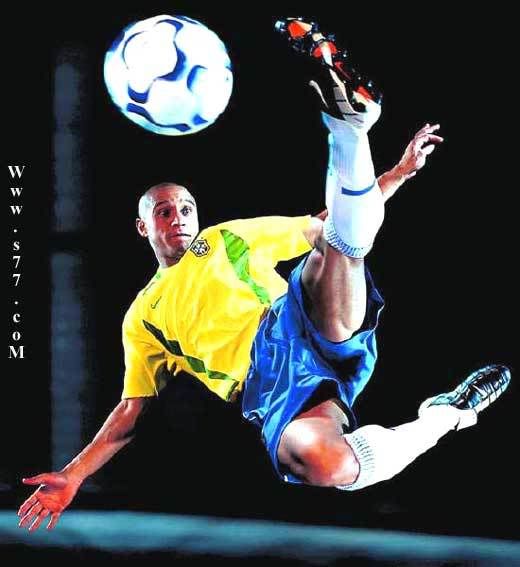
Roberto Carlos

Roberto Carlos da Silva Rocha (born 10 April 1973 in Garça, São Paulo, Brazil) commonly known as simply Roberto Carlos, is a Brazilian footballer. He was a member of the Brazil national team in three World Cups, helping the team reach the final in 1998 and win the 2002 tournament. He is also known for his trademark free kicks, explosive running speed and powerful curling banana trajectory shot.

Roberto Carlos plays for Corinthians in Brazil. Previously he played for Spanish club Real Madrid for 11 years, winning four leagues, three UEFA Champions League trophies, and two Intercontinental Cups. He is also one of only six players to have played more than 100 matches in the Champions League, as of February 2008. He finished second to countryman Ronaldo in the 1997 FIFA World Player of the Year award poll and was named as one of the top 125 greatest living footballers by Pelé in March 2004. Encyclopædia Britannica heralds Roberto Carlos as "an excellent exponent of the wing back position." [source : Roberto Carlos]
 
Roberto Carlos Wallpaper

Memorable Roberto Carlos' Free Kick

Carlos Alberto Torres

Carlos Alberto Torres (born July 17, 1944, Rio de Janeiro) is a former Brazilian footballer, one of the most highly regarded defenders of all time. He captained Brazil to victory in the 1970 World Cup and is a member of the World Team of the 20th Century, as well as the U.S. National Soccer Hall of Fame.

Carlos Alberto joined Fluminense at the age of 19. He made a name for himself in his first season, not only because of his great tackling and reading of the game, but also due to his outstanding ball control, dribbling and playmaking abilities, which were quite rare at the time for a defender. In 1966, he moved to Santos, where he became Pelé's teammate. In 1974, he returned to Fluminense and helped the team capture two consecutive Campeonato Carioca championships. In 1977, he moved to Fluminense's arch-rivals Flamengo.

In 1977, despite a great career in Brazil, Carlos Alberto Torres decided to move to the New York Cosmos where he was reunited with his friend and partner Pelé and helped the Cosmos capture two consecutive NASL titles in 1977 and 1978. After spending one year with the California Surf, he returned to the Cosmos in 1982 where he won his third NASL title. He played his farewell game on September 28 1982 in an exhibition match between the Cosmos and his former club Flamengo. In 119 regular season games and 26 playoff games, Carlos scored a total of 8 goals and was an NASL All-Star five times.

Carlos Alberto Torres is considered a legend among football insiders for his massive contributions to Brazil during an era when centre-backs were to be heard but not seen. From 1964 to 1977, Torres was capped 53 times and scored 8 goals. Perhaps his greatest feat was when he captained Brazil in the 1970 World Cup in Mexico to an impressive victory over Italy. This legendary squad also included Clodoaldo, Gérson, Jairzinho, Roberto Rivelino, Tostão and Pelé. This team scored one of the most memorable team goals against Italy in the final, with Carlos Alberto sauntering down the right wing unmarked to score the fourth goal in their 4-1 defeat of Italy. Carlos Alberto's goal against Italy in the final of the Football World Cup 1970 is considered one of the greatest goals ever scored in the history of the tournament. Despite his spectacular performance during the 1970 cup, he did not participate in the 1974 World Cup due to a knee injury,

Carlos Alberto retired from the Brazil National Team in 1977, right before joining the NASL. Today he is considered one of the finest Brazilian footballers of all time, with the likes of Pelé, Zico, Ronaldo, Garrincha and fellow defenders Roberto Carlos and Nilton Santos. 

His career as a football manager started in 1983, when he managed Flamengo. He also managed several other clubs, like Corinthians in 1985 and 1986; Náutico in 1986, 1987 and 1988; Once Caldas on 1989, 1990; Monterrey in 1991, 1992; Club Tijuana in 1992; Fluminense in 1994 and 1995; Botafogo in 1993, 1994, 1997, 1998, 2002 and 2003; Querétaro FC in 1999; Unión Magdalena in 2000, 2001; and Paysandu
in 2005.

He was also an assistant manager for national teams like Nigeria national football team and Oman national football team. On 14 February 2004 he was appointed manager of Azerbaijan national football team. He resigned on 4 June 2005 after the lost match against Poland, during which he assaulted the technical referee and ran on the pitch suggesting the referee was bribed.

Carlos Alberto's Pictures


Related Posts with Thumbnails