Showing posts with label Coach. Show all posts

Hugo Sánchez Márquez

Hugo Sánchez Márquez (born July 11, 1958), popularly nicknamed Pentapichichi, or Hugol, is a Mexican football coach and former striker. He played for four European clubs, including Real Madrid. Sanchez is considered the first highly talented mexican player. He was also a member of the Mexico national team, and participated in three World Cups.

Sánchez played twelve seasons in the Spanish Primera División and is the second highest goalscorer in the history of that league. He also played for the Mexico national team for 17 years and participated in the World Cups of 1978, 1986, and 1994. He won the Pichichi Trophy five times, four of them consecutively, a record second only to Telmo Zarra's six trophies.

As a coach, he won two championships as head coach of the club Pumas de la UNAM and briefly with Club Necaxa, both teams in the Mexican Primera División. He also had a sixteen-month stint with the Mexican national team, but was fired on March 31, 2008. Hugo Sanchez has signed up to start coaching again, now in Europe, for UD Almería  from the Spanish First Division starting December 29, in an attempt to save the team from descending to the 2nd Division by the Summer. He has succeeded in keeping UD Almeria free from relegation from La Liga for the 2009-2010 season.

In 1999, the IFFHS voted him the 26th best footballer of the 20th Century, and the best footballer from the CONCACAF region. [source : Hugo Sanchez]
 
Hugo Sánchez Márquez Pictures


Just Fontaine

Just "Justo" Fontaine (born 18 August 1933 in Marrakech, French Morocco) is a former French football player whose father was Moroccan and mother was Spanish.

He holds the record for most goals scored in a single FIFA World Cup finals tournament, with 13 in 1958. He has also scored the fourth most goals of any player in the World Cup finals overall, beaten only by Ronaldo, who scored fifteen goals (in four World Cup tournaments), Gerd Müller (in two World Cup tournaments) and Miroslav Klose (in three World Cup tournaments), who both scored fourteen goals. Although France did not win the 1958 World Cup, Fontaine became the second player after Alcides Ghiggia to score in every match of a World Cup.


Though born in Marrakech, he moved to Casablanca, where he attended the Lycée Lyautey.

Fontaine began his amateur career at USM Casablanca, where he played from 1950 to 1953. Nice recruited him in 1953, and he went on to score 44 goals in three seasons for the club. In 1956, he moved on to Stade de Reims where he teamed up with Raymond Kopa, Kopa went to Real Madrid in 1958, Fontaine scored 121 goals in six seasons at the Stade de Reims. In total, Fontaine scored 165 goals in 200 matches in the Ligue 1, and twice won the championship; in 1958 and 1960.

Wearing the blue shirt of France, Fontaine's statistics are even more impressive. On his debut with the team on 17 December 1953, Fontaine scored a hat trick as France defeated Luxembourg 8-0. In seven years, he scored 30 goals in 21 matches for the national team. However, Fontaine will best be remembered for his 1958 FIFA World Cup performance, where he scored 13 goals in just six matches—a feat which included putting four past the defending champions West Germany. It was also the highest number of goals ever scored by one player at a single World Cup tournament - a record which still stands today. This tally secured him the Golden Boot for that tournament.

Fontaine played his last match in July 1962, being forced to retire early because of a recurring injury. He briefly managed the French national team in 1967, but was replaced after only two games, both friendlies that ended in defeats. As coach of Morocco, he led the Atlas Lions to 3rd in the 1980 African Cup of Nations, overseeing the emergence of such players as Badou Zaki, Mohammed Timoumi and Aziz Bouderbala. Morocco reached the final stage of 1982 World Cup qualifying but were beaten by Cameroon. [source : Fontaine]


Just Fontaine Pictures

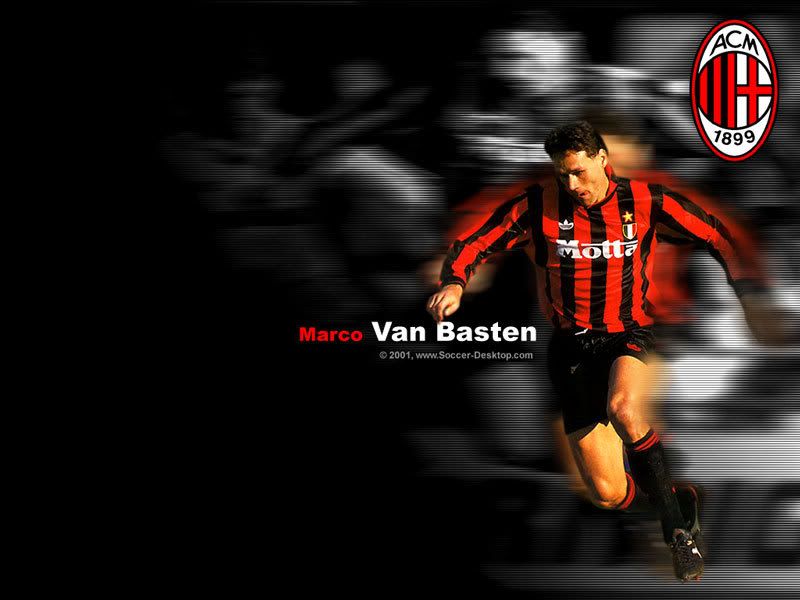
Marco van Basten

Marcel "Marco" van Basten (31 October 1964) is a Dutch football manager and former head coach of Eredivisie side AFC Ajax and the Dutch national team. 

Previously, he was a football player who played for Ajax and A.C. Milan in the 1980s and early 1990s. He is regarded as one of the greatest forwards of all time and scored 277 goals in a career cut short by injury. 
Young van Basten and Kluivert

Marco van Basten was known for his strength on the ball, his tactical awareness and spectacular strikes and volleys, van Basten was named European Footballer of the Year three times (1988, '89 and '92) and FIFA World Player of the Year in 1992. Van Basten was voted eighth in a poll organised by the French weekly magazine France Football consulting their former Ballon d'Or winners to elect the Football Player of the Century. 

In 2004, a nationwide pool was held for the 100 greatest Dutch people (De Grootste Nederlander) and van Basten was number 25, the second highest for a football player. [source : Marco van Basten]

Pictures


Ferenc Puskás

Ferenc Puskás (Hungarian pronunciation: [ˈfɛrɛnt͡s ˈpuʃkaːʃ]; born Ferenc Purczeld Biró (German: Franz Purzfeld); 2 April 1927 – 17 November 2006) was a Hungarian footballer and manager who is regarded as one of the greatest footballers of all time. He scored a remarkable 84 goals in 85 international matches for Hungary, and 514 goals in 529 matches in the Hungarian and Spanish leagues. He was voted one of the greatest players of the 20th century by World Soccer magazine.

Puskás started his career in Hungary playing for Kispest and Budapest Honvéd. He was top scorer in the Hungarian League on four occasions, and in 1948, he was the top goal scorer in Europe. During the 1950s, he was both a prominent member and captain of the legendary Hungarian national team, known as the Mighty Magyars. In 1958, two years after the Hungarian Revolution, he emigrated to Spain where he played for the legendary Real Madrid team that also included Alfredo di Stéfano, Francisco Gento, Raymond Kopa, Héctor Rial, and José Santamaría and went on to play for Spain.

While playing with Real Madrid, Puskás won four Pichichis and scored seven goals in two European Champions Cup finals. In 1995, he was recognized as the top scorer of the 20th century by the IFFHS.

After retiring as a player, he became a coach. The highlight of his coaching career came in 1971 when he guided Panathinaikos to the European Cup final, where they lost 2–0 to AFC Ajax. Despite his defection in 1956, Puskás remained an admired hero in Hungary. In 1993, the Hungarian government granted him a full pardon, allowing to return and take temporary charge of the Hungarian national team. In 1998, he became one of the first ever FIFA/SOS Charity ambassadors. In 2002, the Népstadion in Budapest was renamed the Puskás Ferenc Stadion in his honor. He was also declared the best Hungarian player of the last 50 years by the Hungarian Football Federation in the UEFA Jubilee Awards in November 2003. In October 2009, FIFA announced the introduction of the FIFA Puskás Award, awarded to the player who has scored the "most beautiful goal" over the past year. The inaugural Puskás Award was presented on December 21, 2009 at the FIFA World Player Gala where Cristiano Ronaldo was the first player who got this prize. [source : Puskás]

Ferenc Puskás' Pictures
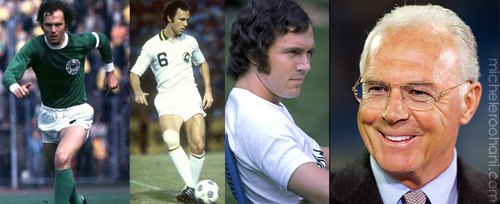
Franz Beckenbauer : Der Kaiser

Franz Anton Beckenbauer (born 11 September 1945) is a German football coach, manager, and former player, nicknamed Der Kaiser ("The Emperor") because of his elegant style, his leadership, his first name "Franz" (reminiscent of the Austrian emperors), and his dominance on the football pitch. He is generally regarded as the greatest German footballer of all time and one of the greatest and most decorated footballers in the history of the game.

Beckenbauer was a versatile player who started out as a midfielder but made his name as a defender. He is often credited as having invented the role of the modern sweeper or libero.

Twice selected the European Footballer of the Year, he appeared 103 times for West Germany and played in three World Cups. He lifted the World Cup trophy as captain in 1974, and repeated the feat as a manager in 1990. With the club Bayern Munich, he won three consecutive European Cups from 1974 to 1976, and the Cup Winners' Cup in 1967. Beckenbauer is the only player to captain three European Cup winning sides. He went on to become coach and president of the institution. He is also a member of the National Soccer Hall of Fame.

In 1999, he was voted second place, behind Johan Cruyff, in the European player of the Century election held by the IFFHS and he was voted third, behind Pelé and Cruyff, in the IFFHS' "World Player of the Century" election.

Today, Beckenbauer remains an influential figure in both German and international football. He led Germany's successful bid to host the 2006 FIFA World Cup and chaired the organizing committee. He also works as a pundit for German television network Sat.1 during their coverage of the UEFA Champions League and writes a football column for mass tabloid Bild.
[source : Franz Beckenbauer]

Franz Beckenbauer's Pictures

Johann Cruyff : The Dutch Meister

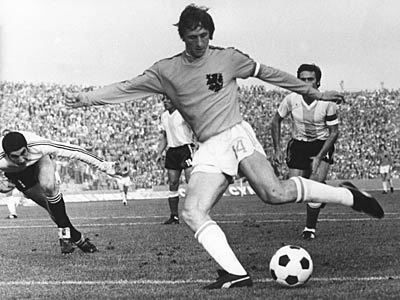
Hendrik Johannes Cruijff (born  April 25, 1947, in Amsterdam), is a Dutch football legend. He won the Ballon d'Or three times—in 1971, 1973 and 1974, which is a record jointly held with Michel Platini and Marco van Basten. Cruyff was the most famous exponent of the football philosophy known as Total Football explored by Rinus Michels, and is widely regarded as one of the greatest players of all time.

After his retirement from playing in 1984, Cruyff became highly successful as manager of Ajax and later Barcelona; he remains an influential advisor to both clubs. His son Jordi has also gone on to play football professionally.

In 1999, Cruyff was voted European Player of the Century in an election held by the IFFHS, and came second behind Pelé in their World Player of the Century poll. He came third in a vote organised by the French weekly magazine France Football consulting their former Ballon d'Or winners to elect their Football Player of the Century.

On November 2, 2009, Cruyff was named as manager of the Catalonian national team in place of Pere Gratacòs. This is his first coaching job in thirteen years. [source : Cruyff]


Johann Cruyff's Pictures

Maradona : Hand of God

Diego Armando Maradona (born 30 October 1960 in Lanús, Buenos Aires) is an Argentine former football player and the current manager of the Argentine national team. He is widely regarded as one of the best football players of all time. He finished first in an internet vote for the FIFA Player of the Century award, and he shared the award with Pelé.

Hand of God Goal
Over the course of his professional club career Maradona played for Argentinos Juniors, Boca Juniors, Barcelona, Napoli, Sevilla and Newell's Old Boys, setting world-record contract fees. In his international career, playing for Argentina, he earned 91 caps and scored 34 goals. He played in four FIFA World Cup tournaments, including the 1986 World Cup where he captained Argentina and led them to their victory over West Germany in the final, winning the Golden Ball award as the tournament's best player. In that same tournament's quarter-final round he scored two goals in a 2–1 victory over England that entered football history, though for two very different reasons. The first goal was an unpenalized handball known as the "Hand of God", while the second goal was a spectacular 60-metre weave through six England players, commonly referred to as "The Goal of the Century".

Maradona with Lionel Messi
For various reasons, Maradona is considered one of the sport's most controversial and newsworthy figures. He was suspended from football for 15 months in 1991 after failing a doping test for cocaine in Italy, and he was sent home from the 1994 World Cup in the USA for using ephedrine.

After retiring from playing on his 37th birthday in 1997, he increasingly suffered ill health and weight gain, hardly helped by ongoing cocaine abuse. In 2005 a stomach stapling operation helped control his weight gain. After overcoming his cocaine addiction, he became a popular TV host in Argentina.

His outspoken manners have sometimes put him at odds with journalists and sport executives. Although he had little previous managerial experience, he became head coach of the Argentina national football team in November 2008.

[source: Maradona]


Maradona's Wallpaper


Related Posts with Thumbnails