Showing posts with label Manager. Show all posts

Sir Geoff Hurst

Born 8 December 1941 in Ashton-under-Lyne, Lancashire, Sir Geoffrey Charles Hurst MBE (Geoff Hurst) is a retired England footballer best remembered for his years with West Ham. 

Geoff Hurst made his mark in World Cup history as the only player to have scored a hat-trick in a World Cup final. His three goals came in the 1966 final for England in their 4–2 win over West Germany at the old Wembley. Such an achievement was made all the more remarkable by the fact that he was only five months and eight games into his international career, and was not considered his country's premier center forward.

Geoff Hurst was initially a strong-running midfielder but was converted to a striker by manager Ron Greenwood. West Ham won the FA Cup in 1964 with Hurst scoring the second equalizer in a tight and exciting 3–2 victory over Preston North End at Wembley. A year later, Hurst was back at Wembley for the final of the European Cup Winners Cup against 1860 Munich, and West Ham won 2–0. The following season he was in the West Ham side which lost the League Cup final on aggregate to West Bromwich Albion.

In February 1966 he was given his debut for England by manager Alf Ramsey. Geoff Hurst was named in the 22-man World Cup squad for the finals in England. Ramsey’s decision paid dividends as Hurst scored three goals to help England wins their World Cup title.
 
Geoff Hurst remains the most recent British-based player to notch a double hat-trick in a top-flight league match: he achieved this remarkable feat in a First Division match against Sunderland at Upton Park on 19 October 1968, which saw the Hammers defeat the Wearsiders 8-0.

Geoff Hurst wound down his career with Stoke City, West Bromwich Albion, Seattle Sounders (NASL). After Seattle, Hurst played in Kuwait and then signed for Cork Celtic. 

Upon his retirement from playing, Geoff Hurst moved into management and coaching. He was assistant to his ex-West Ham boss Ron Greenwood after the latter took over the England job in 1977, player-manager of Telford United and manager of Chelsea from 1979–81. He joined Chelsea, then in the Second Division, before the 1979–80 season, initially as assistant manager to Danny Blanchflower. When Blanchflower was sacked, Geoff Hurst was appointed manager. [source : Geoff Hurst]

Sir Geoff Hurst Pictures
 

Hong Myung-Bo

Hong Myung-Bo (born February 12, 1969 in Seoul) is a former South Korean footballer who, along with Cha Bum Kun, is often considered among the greatest Asian footballers ever. Hong was a member of the Korean national team in four World Cups, and was the first Asian player to play in four consecutive World Cup finals tournaments. He played as either a centre-back or at full-back. He retired from playing following the end of the 2004 Major League Soccer season, having finished his career with the Los Angeles Galaxy. He was chosen among the "FIFA 100", Pelé's selection of the 125 greatest living footballers in the world. He was also the recipient of the 2002 FIFA World Cup Bronze Ball. No other Asian player has yet achieved this feat.

Hong's first appearance at a World Cup final was at the 1990 World Cup in Italy. Hong played in all of Korea's matches against Belgium, Spain, and Uruguay, all three of which Korea lost.

Hong's individual talent was most notably showcased during the 1994 World Cup group stage. With Korea trailing 2–0 against Spain with only 5 minutes to go, Hong made the score 2–1 and shortly after he created the second for winger Seo Jung-Won to equalize the memorable match.

Hong's third appearance at World Cup was 1998 France World Cup. Hong played all three games of Korea against Mexico, Netherlands and Belgium. Korea got eliminated at the first round with 1 draw (Belgium) and 2 losses (Mexico and Netherlands).

Hong captained the Korean national team to a historic fourth place finish in the 2002 World Cup. He scored the winning penalty to secure a 5–3 shootout victory in the quarter final against Spain after a goalless draw. The Technical Study Group voted him as the third best player of the tournament (Bronze Ball award), the first ever Asian to be named in the top 3 players in a World Cup. Leader of the Korean defensive trio alongside Kim Tae-Young and Choi Jin-Cheul, he ended his international career after the 2002 World Cup as the all-time leader in appearances for the South Korean national team, with 135 caps.

On September 26, 2005, after retirement as a player, Hong returned to the national team as an assistant coach. Helping the manager Dick Advocaat, he took part in the 2006 FIFA World Cup, and worked with the next manager Pim Verbeek in the Asian Cup 2007. After the resign of Pim Verbeek, he was one of the candidates to become the next manager. The Korea Football Association announced, on 19 February 2009, it had appointed him as the South Korea national under-20 football team. Under his guidance the team reached the quarter finals of the tournament, but were eliminated due to a 2–3 defeat to Ghana national under-20 football team. He also served an assistant coach for under-23 football team under Park Seong-Hwa. Following Park resigned as head coach in October 2009, he took over the coaching duties at under-23 football team. He led his team into third place in the 2010 Asian Games. [source : Hong Myung Bo]

Kenny Dalglish

Kenneth Mathieson "Kenny" Dalglish (Scottish pronunciation: 'kɛni: dɛɫgli:ʃ') MBE (born 4 March 1951) is a former Scottish footballer and current manager of Liverpool F.C. In 2009, he was named by FourFourTwo football magazine as the greatest striker in post-war British football.

In a 20-year playing career, Dalglish played for two teams, Celtic and Liverpool, achieving success with both. Dalglish is the most capped Scottish player, with 102 appearances. He and Denis Law also share the record for most goals for Scotland, with 30 each.

Dalglish began his career with Celtic and became the team captain in 1975. Between 1971 and 1977 he won four Scottish First Division titles, four Scottish Cups and one Scottish League Cup. In 1977, Bob Paisley paid a British transfer record of £440,000 to bring Dalglish to Liverpool.

His years at Liverpool marked one of the club's most prolific periods: he won seven league titles, three European Cups and five domestic cups. For these achievements, he is nicknamed King Kenny, and he was placed first in Liverpool's list of "100 Players Who Shook the Kop". Dalglish became player-manager of Liverpool in 1985 following the Heysel Stadium Disaster and brought the team a league and FA Cup double in his first year in charge, beating Merseyside rivals Everton in the process. During his six-year tenure from 1985–1991, Liverpool won the league championship three times and the FA Cup twice.

Kenny Dalglish joined Blackburn Rovers in 1991 and he turned the Second Division side into Premier League winners in 1995. His move to Newcastle United in 1997 was less successful. Dalglish was appointed Director of Football at Celtic in 1999 but a stint as caretaker manager ended in an acrimonious departure the following year.

Between 2000 and 2010 Dalglish focused on charitable concerns, founding The Marina Dalglish Appeal with his wife to raise money for cancer care. On 8 January 2011, Dalglish became Liverpool's manager for a second time, after the departure of Roy Hodgson. [source : King Kenny]

Kenny Dalglish Pictures and Wallpapers


Alan Shearer

Alan Shearer OBE, DL (born 13 August 1970) is a retired English footballer. He played as a striker in the top level of English league football for Southampton, Blackburn Rovers, Newcastle United and for the England national team. 

Alan Shearer is widely considered as one of England's best ever strikers, being both Newcastle's and the Premier League's record goalscorer. After retiring as a player, Shearer now works as a television pundit for the BBC. Toward the end of his playing career, Shearer worked towards gaining the UEFA Pro Licence, and expressed a desire to eventually become a manager. In 2009 he briefly left his BBC role to become Newcastle United's manager in the last eight games of their 2008–09 season, in an unsuccessful attempt to save them from relegation.

A native of Newcastle upon Tyne, Shearer made his professional debut with English top-flight club Southampton in 1988, scoring a hat-trick in the process. During several years on the south coast, he became known for his classic style of play, strength and goalscoring ability; he soon received an international call-up along with a transfer to Blackburn Rovers in 1992. 

Shearer established himself as a player in northern England; he became a regular in the England squad, and his 34-goal tally helped Blackburn secure the Premier League title in 1994–95. He was named Football Writers' Association Player of the Year in 1994 and won the PFA Player of the Year award in 1995. The 1995–96 season saw Shearer make his first Champions League appearances and finish as the top scorer in the Premier League with 31 goals. He was also top scorer at Euro 1996 with England, scoring five goals, and in the 1996–97 Premier League, with 25 goals.

A world-record £15 million move to his boyhood heroes, Newcastle United, followed the Euro '96FA Cupcaptain in 1996 and Newcastle's captain in 1999, he retired from international football following Euro 2000, having amassed 63 appearances and 30 goals for his country. tournament, and Shearer spent the remainder of his career with the club. While he would never emulate the success of his time at Blackburn Rovers, Shearer won runners-up medals in the Premier League and with Newcastle, and a second PFA Player of the Year award. After being named England's captain in 1996 and Newcastle's captain in 1999, he retired from international football following Euro 2000, having amassed 63 appearances and 30 goals for his country.

As well as his media work, he has raised substantial amounts of money for various national and local charities, both within and outside of sports. Shearer is an Officer of the Order of the British Empire (OBE), a Deputy Lieutenant of Northumberland, a Freeman of Newcastle upon Tyne and an honorary Doctor of Civil Law of Northumbria and Newcastle Universities. [source : Alan Shearer]

Alan Shearer Pictures and Wallpapers


Josep "Pep" Guardiola

Josep "Pep" Guardiola i Sala (born 18 January 1971 in Santpedor, Barcelona, Catalonia), is a Catalonian football manager and former player. Guardiola played as a defensive midfielder and spent the majority of his playing career with FC Barcelona, whom he currently manages. 

Pep Guardiola was part of Johan Cruyff's dream team that won Barcelona's first European Cup. Guardiola also played for Brescia Calcio, A.S. Roma, Al-Ahli and Dorados de Sinaloa. As an international, he played for Spain and Catalonia.

After retiring as a player, Guardiola became coach of FC Barcelona B. On 8 May 2008, Barcelona president Joan Laporta announced that Guardiola would succeed Frank Rijkaard as the first team manager. He signed his contract on 5 June 2008. In his first season as manager, Barcelona won the treble of La Liga, the Copa del Rey and the Champions League. In doing so, Guardiola became the youngest UEFA Champions League winning manager ever. 

The following season, Guardiola and Barcelona won the Supercopa de España against Athletic Club Bilbao, the UEFA Super Cup against Shakhtar Donetsk, and the FIFA Club World Cup against Estudiantes, bringing the manager's tally to the maximum of six trophies in six competitions in one year, thus completing the first ever sextuple. [source : Pep Guardiola]

Pep Guardiola Pictures and Wallpapers

Omar Sívori : El Cabezón

Enrique Omar Sívori was born in San Nicolas (Argentina) on October 2nd, 1935. He started kicking the ball in the town theatre. Then he got to CA River Plate of Renato Cesarini, former player of Juventus FC. Sivori was soon nicknamed "El Cabezón" (because of his big head) or "el gran zurdo" (because of his sensational left foot shot).
 
With the "blancorojos" of Buenos Aires Sivori became Argentina champion three times in a row, from 1955 to 1957. Again in 1957 with the Argentine selection he won the Copa America (the South American nations' championship) played in Peru with Maschio and Angelillo in the unrestrainable central attacking trio that was named "the angels with dirty faces".

Shortly after Sivori moved to Italy and to Juventus FC to which the player was indicated by Cesarini himself. He was paid a good 160 million lire, an incredible figure at that time that allowed River Plate managers to renovate a whole stand (that now holds his name) of their stadium.
 
Shortly after his arrival in Torino, Sivori showed all his talent. He was not able to play in an ordinary way, he was born to amaze, to amuse and to have fun. Incommensurable with his dribblings and his feints, he scored and made his team-mates score, cheating his opponents with his socks down, his tunnels and his hot-blooded and disrespectful character. And his character was really one of his limits: in his twelve years in Italy he piled up a good 33 days' disqualification.
 
He played for Juventus FC for 8 seasons, won 3 scudetti (Serie A titles) and 3 Italy Cups scoring 167 goals in 253 matches. In 1960 with 28 goals he was the top scorer of the Italian championship. In 1961 "France Football" gave him the prestigious "Ballon d'Or". In 1965 Sivori moved to SS Napoli where with the Brazilian player José Altafini threw all the Parthenopean supporters into raptures. He ended his career also because of a heavy disqualification just before the end of the 1968-69 championship and returned to Argentina.
 
Once naturalized Italian, Omar Sivori wore also the Italian selection shirt nine times, scored 8 goals and played the unlucky world championship in Chile in 1962. Afterwards he worked also as a talent-scout for Juventus FC in South America, and he was also a biting, as usual, TV commentator. Omar Sivori died from pancreas cancer when he was 69 on February 18th, 2005. He died in San Nicolas, a city about 200 km far from Buenos Aires, where he was born and where he lived for a long time. There he had also a farm named "Juventus" after the team he loved most. [source : Sivori]

Omar Sivori Pictures


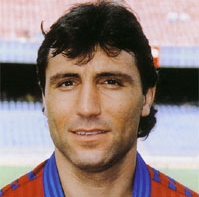
Hristo Stoichkov

Hristo Stoichkov, better known as "Itso" among his friends, was born in Plovdiv, Bulgaria on 8th February 1966. He grew up being influenced by his father who often participated as a goalkeeper in the local team of Maritsa, Plovdiv. Though Stoichkov began with a slow start, the young talent started playing for the team by the age of 10. In 1984, Stoichkov started to play for the team of Hebar Harmanli. Hristo Stoichkov’s passion and competitive drive have transformed him to be one of the top football players of the 20th Century. His amazing talent, sizzling temper and willpower to succeed have helped him in his journey of professional triumph.   

His genius play with Hebar received instant recognition. In 1985 the Manager of CSKA noticed his skills and decided to select him to play for CSKA Sofia under the management of coach Dimitar Penev. Penev known for developing young talents, helped to nurture Stoichkov’s skills. From 1986-1989, he played for CSKA and became a football hero. In his first season with CSKA, he helped the team to win the Bulgarian cup and the Championship. Soon he became a known figure in Bulgarian football with his unique experience and on-field achievements. He became the top goal scorer in the 1989 season by scoring 23 goals. He also won the Golden Boot for Top Goal Scorer in Europe and Bulgaria.

Though his team was defeated by Barcelona in the semi-finals, Stoichkov's excellent footwork caught the attention of Johan Cruyff, who was the coach of Barcelona. He signed Stoichkov to play for Barcelona for a deal worth $4.5 million. From 1990-1994, while playing for Barcelona he scored some 100 goals. He led the team to win the Spanish Primera Division Championship four years in a row and won the Champion's League in 1992. With his gripping power, precision and a temper that annoyed his opponents, Stoichkov became an idol for million supporters. He also led the Bulgarian National team to the World Cup in 1994. The team had an extremely successful tournament and finished third place.

In 1994, Parma offered him $15 million to play for their team. Though he played for Parma for a year, he returned back to Barcelona in 1997. On his return to Barcelona, he won the Spanish Super Cup, the Spanish Championship, the European Cup and the Spanish King's Cup. The same year, Barcelona loaned Stoichkov to Al-Nasr, Saudi Arabia where he won the Asian Cup Winners Cup..

Stoichkov continued his career in the US where he joined the MLS. In 2000, he was allocated by MLS to Chicago fire and helped the team to win the MLS Cup Final. The year 2000, proved to be a good year for him as he was named among MLS's Best 11 and was one of the finalists for the MLS Goal of the Year award.

Stoichkov is the greatest player for Bulgarian National team. He scored six goals to take Bulgaria to the world cup semi-finals in 1994. Stoichkov named as the European footballer of the year for 1994. Totally, he scored 37 goals for Bulgaria in 83 matches. He quit from international football in 1999.

Soon after his retirement, Stoichkov tried his luck as a coach, initially with the Bulgarian national team. Failing to qualify for the 2006 World Cup, he resigned and moved back to Spain. He was hired as a head coach for Celta Vigo. In the same season, his club was relegated from Primera Division. And then he joined with a South African's club, Mamelodi Sundowns. [source : Stoitchkov]

Stoichkov Pictures and Wallpapers


Related Posts with Thumbnails