Showing posts with label Second-Striker. Show all posts

Wayne "Wazza" Rooney

Wayne Mark Rooney (born 24 October 1985) is an English footballer who plays as a striker for Premier League club Manchester United and the England national team. He was nicknamed with "Wazza" he is compared with former England player Paul "Gazza" Gascoigne.

Wayne Rooney was born in Croxteth, Liverpool to Thomas Wayne and Jeanette Marie Rooney (née Morrey). He grew up supporting his local club Everton; his childhood hero was Duncan Ferguson. At age nine, Rooney joined the youth team of Everton, for whom he made his professional debut in 2002. 

Wayne Rooney spent two seasons at the Everton, before moving to Manchester United for £25.6 million in the 2004 summer transfer window. Since then, United have won the Premier League four times, the 2007–08 UEFA Champions League and two League Cups with Rooney in the team. He also holds two runner-up medals from both the Premier League and the Champions League. Wayne Rooney is the third Manchester United player to score 100 Premier League goals, joining Ryan Giggs and Paul Scholes. 

Wayne Rooney made his senior international debut in 2003 at seventeen, the same age at which he also became the youngest player to score an England goal. He played at UEFA Euro 2004 and scored four goals. He also briefly became the competition's youngest goalscorer. He is frequently selected for the England squad and also featured at the 2006 and 2010 World Cups. Rooney has won the England Player of the Year award twice, in 2008 and 2009. As of March 2011, he has won 70 international caps and scored 26 goals.

In 2009-10, Rooney was awarded the PFA Players' Player of the Year and the FWA Footballer of the Year. As of 2011, he is the third highest-paid footballer in the world, with an annual income of €20.7m (£18m) including sponsorship deals. [source : Wayne Rooney]

Wayne Rooney Pictures and Wallpapers
 

Lionel "The Messiah" Messi

Lionel Andrés Messi (born 24 June 1987) is an Argentine footballer who currently plays for FC Barcelona and the Argentina national team as a forward or winger. He also holds Spanish citizenship, which makes him eligible as a EU player. Considered one of the best football players of his generation and frequently cited as the world's best contemporary player, Messi received several Ballon d'Or and FIFA World Player of the Year nominations by the age of 21 and won both by the age of 22. His playing style and ability have drawn comparisons to Diego Maradona, who himself declared Messi his "successor".

Messi began playing football at a young age and his potential was quickly identified by FC. Barcelona. He left Rosario-based Newell's Old Boys's youth team in 2000 and moved with his family to Europe, as Barcelona offered treatment for his growth hormone deficiency. Making his debut in the 2004–05 season, he broke his team record for the youngest footballer to score a league goal. Major honours soon followed as Barcelona won La Liga in Messi's debut season, and won a double of the league and Champions League in 2006. His breakthrough season was in the 2006–07 season; he became a first team regular, scoring a hat-trick in El Clásico and finishing with 14 goals in 26 league games. Perhaps his most successful season was the 2008–09 season, in which Messi scored 38 goals to play an integral part in a treble-winning campaign. In the following 2009–10 campaign, Messi scored 47 goals in all competitions, equalling Ronaldo's record total for Barcelona.

Messi was the top scorer of the 2005 FIFA World Youth Championship with six goals, including two in the final game. Shortly thereafter, he became an established member of Argentina's senior international team. In 2006, he became the youngest Argentine to play in the FIFA World Cup and he won a runners-up medal at the Copa América tournament the following year. In 2008, in Beijing, he won his first international honour, an Olympic gold medal, with the Argentina Olympic football team. 

Messi was named winner of the 2009 Ballon d'Or on 1 December 2009, beating runner-up Cristiano Ronaldo by largest ever margin of 473 to 233. And on 21 December, Messi was given the FIFA World Player of the Year award; beating Cristiano Ronaldo, Xavi, Kaká and Andrés Iniesta to the award. This was the first time he had won the award, and he became the first Argentinean to ever receive this honour. [source : Messi]

Lionel Messi Wallpaper


Ronaldinho

Ronaldo de Assis Moreira or popularly known as Ronaldinho Gaúcho was born on the 21st of March, 1980 in Porto Alegre, capital of the southernmost Brazilian state of Rio Grande do Sul.

Ronaldinho's name was given in order to differentiate between himself and Ronaldo Luis Nazario de Lima, also better known to the world as Ronaldo. Ronaldo himself was known as Ronaldinho when Ronaldo Guiaro was called Ronaldo, and at that time Ronaldinho also had the word Gaucho attached to his name. Ronaldinho is Portuguese for ''little Ronaldo''.

Roberto Assis, Ronaldinho's elder brother was a pretty good footballer himself. He played for Gremio under Luiz Felipe Scolari before injuries forced him out of the game at an early age. With his father, who had died when Ronaldinho was 8, having been a supporter of Gremio as well, it was but natural that Ronaldinho joined the club. He starred in Brazil's first ever win at the U-17 Championships, held in Egypt in 1997. Ronaldinho made his first senior appearance for Gremio at the Copa Libertadores in 1998.

Ronaldinho's greatest assets have been his ball control, agility and trickery. He can dribble and pass like few people can, and defenders can feel like utter fools when they are up against him. He slowly made a name for himself at Gremio, and was inducted into the Brazilian team in 1999. He made his international debut against Latvia in June 1999, and was part of the Brazilian team which won the Copa America in the same year. He won both the Golden Ball and the Golden Boot at the 1999 Confederations Cup. He scored in every game Brazil played, and missed the final due to injury, where they lost to Mexico.

As the 21st century started, news of Ronaldinho's abilities spread far and wide. Despite interest from England, he decided to move to France to join Paris St.Germain at the end of the 2001 season.  The 2002 World Cup firmly established Ronaldinho as a man destined for great things. His goal knocked England out at the quarterfinal stage - a freekick from the right which was completely misjudged by opposition goalkeeper David Seaman. Brazil went on to beat Germany in the final, and clubs started queueing up for the playmaker. With PSG not winning trophies in Europe, he had to make a move to further his career. Although Manchester United and FC Barcelona were both interested in his services, he transferred to the Catalans for a fee of £21 million.
 
Ronaldinho first played in a Barca jersey against AC Milan in America, scoring the second goal for the Catalans. He helped Barcelona to a second place in the league in the 2003-2004 season, despite being injured for most part of the first half. Ronaldinho epitomises the way the beautiful game should be played. Along with Deco, Samuel Etoo, Ludovic Giuly and Lionel Messi, he transformed Barcelona into a supremely gifted attacking side.

There is probably no limit to Ronaldinho's skills. The ability to play comes to him naturally, and the ball looks alive when at his feet- something similar to magic for extremely gifted magicians, you could say. He virtually conjured a goal out of nowhere, toe punting the goal past a stunned Chelsea defence and Petr Cech in the quarterfinals of the Champions League. To toe punt is an extremely difficult thing to do, and requires extreme accuracy. It was therefore no surprise that when Ronaldinho made his move, the rest of the players just stood where they were and watched awestruck.

Barcelona won the La Liga twice in a row, in 2005 and 2006. They also won the Spanish cup in those two years, and also added the Champions League to their trophy cabinet by beating Arsenal in May 2006. Ronaldinho had a part in everything good that happened at the club. Although the 2006 World Cup campaign was a disappointment for him and the national side, there is no doubt that Ronaldinho will want to have another shot in the next edition to be held in South Africa.

From winning the FIFA World Player twice, Ronaldinho had to be content with a fifth placed finish in 2007. He was not called  up for for the 2007 Copa America by new coach Dunga, which Brazil won by beating Argentina.

In April 2008, Ronaldinho tore a muscle in his right leg and missed the rest of Barcelona's season, including their Champions League semifinal against Manchester United. Rumours flew thick and fast about his future, and Manchester City, Inter Milan and A.C.Milan were among the clubs interested. He was eventually sold to AC Milan for 21 million euros, and took the No.80 jersey as Clarence Seedorf already had the No.10 jersey at the San Siro.

He has shown glimpses of his former abilities at Milan, and scored his first goal for the Rossoneri in the city derby against Inter in September 2008.

Apart from his individual abilities, his mere presence on the field instills a new level of confidence in his teammates, and the opposition mentally loses the game even before it has started. It is amazing what one man can do, and words are not enough to describe the man that Ronnie is. He is part of Pele's list of ''125 Greatest living footballers''. In a survey conducted by a Brazilian magazine, he was also inducted into the Gremio all time favourite team. [source : Ronaldinho]

Ronaldinho Pictures and Wallpapers


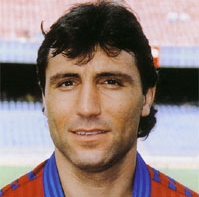
Hristo Stoichkov

Hristo Stoichkov, better known as "Itso" among his friends, was born in Plovdiv, Bulgaria on 8th February 1966. He grew up being influenced by his father who often participated as a goalkeeper in the local team of Maritsa, Plovdiv. Though Stoichkov began with a slow start, the young talent started playing for the team by the age of 10. In 1984, Stoichkov started to play for the team of Hebar Harmanli. Hristo Stoichkov’s passion and competitive drive have transformed him to be one of the top football players of the 20th Century. His amazing talent, sizzling temper and willpower to succeed have helped him in his journey of professional triumph.   

His genius play with Hebar received instant recognition. In 1985 the Manager of CSKA noticed his skills and decided to select him to play for CSKA Sofia under the management of coach Dimitar Penev. Penev known for developing young talents, helped to nurture Stoichkov’s skills. From 1986-1989, he played for CSKA and became a football hero. In his first season with CSKA, he helped the team to win the Bulgarian cup and the Championship. Soon he became a known figure in Bulgarian football with his unique experience and on-field achievements. He became the top goal scorer in the 1989 season by scoring 23 goals. He also won the Golden Boot for Top Goal Scorer in Europe and Bulgaria.

Though his team was defeated by Barcelona in the semi-finals, Stoichkov's excellent footwork caught the attention of Johan Cruyff, who was the coach of Barcelona. He signed Stoichkov to play for Barcelona for a deal worth $4.5 million. From 1990-1994, while playing for Barcelona he scored some 100 goals. He led the team to win the Spanish Primera Division Championship four years in a row and won the Champion's League in 1992. With his gripping power, precision and a temper that annoyed his opponents, Stoichkov became an idol for million supporters. He also led the Bulgarian National team to the World Cup in 1994. The team had an extremely successful tournament and finished third place.

In 1994, Parma offered him $15 million to play for their team. Though he played for Parma for a year, he returned back to Barcelona in 1997. On his return to Barcelona, he won the Spanish Super Cup, the Spanish Championship, the European Cup and the Spanish King's Cup. The same year, Barcelona loaned Stoichkov to Al-Nasr, Saudi Arabia where he won the Asian Cup Winners Cup..

Stoichkov continued his career in the US where he joined the MLS. In 2000, he was allocated by MLS to Chicago fire and helped the team to win the MLS Cup Final. The year 2000, proved to be a good year for him as he was named among MLS's Best 11 and was one of the finalists for the MLS Goal of the Year award.

Stoichkov is the greatest player for Bulgarian National team. He scored six goals to take Bulgaria to the world cup semi-finals in 1994. Stoichkov named as the European footballer of the year for 1994. Totally, he scored 37 goals for Bulgaria in 83 matches. He quit from international football in 1999.

Soon after his retirement, Stoichkov tried his luck as a coach, initially with the Bulgarian national team. Failing to qualify for the 2006 World Cup, he resigned and moved back to Spain. He was hired as a head coach for Celta Vigo. In the same season, his club was relegated from Primera Division. And then he joined with a South African's club, Mamelodi Sundowns. [source : Stoitchkov]

Stoichkov Pictures and Wallpapers


Il Capitano Francesco Totti

Francesco Totti was born at Porta Metronia, Rome, Italy, on 27th September in 1976. He is the current captain of Serie A club AS Roma. Totti has spent his entire career at Roma, is the number-one goalscorer and the most capped player in the club's history. He is widely regarded as one of the finest players in his generation and also one of Roma's greatest players ever. Totti is member of  2006 World Cup winner, Italian national team. 

Francesco Totti is one of the most exciting and impressive attacking footballers to emerge in this generation and is widely recognised as AS Roma's talisman having never left the club to play elsewhere. Totti made his first appearance for Roma at the age of only 16 and his talent coupled with an eagerness to impress was soon rewarded as he forced himself into a regular place in the first team. His development at the club continued in earnest and he was named Serie A Player of the Year both in 2000 and in 2003. Totti's influence in the squad was one of the major factors that contributed to AS Roma securing the Italian league title at the end of the 2001 season with the young man scoring thirteen goals for his team. Totti’s outstanding performances for Roma continued as Totti was moulded into the player and creative genius that we know and love today. In the 2006-07 season Totti scored an impressive tally of 26 goals securing the trophy for the top goal scorer in the League as well as the European Golden Boot.

In international football Totti has played as a regular for the Italian national squad since he first made his senior debut in 2000. Totti was a member of the successful Italian squad that lifted the 2006 FIFA World Cup. He announced his retirement from the national team in July 2007 emphasizing that he wishes to concentrate on his domestic football with AS Roma.

Totti has won many individual awards, including a record five Italian Footballer of the Year awards and two Serie A Footballer of the Year awards. He was named by Pelé as one of the top 125 greatest living footballers in March 2004. He is currently the top active Serie A goalscorer, and sixth all-time in league history with 192 goals. In 2010, Totti awarded with The Golden Foot Award (an international football award, given to players who stand out for their athletic achievements -both as individuals and team players- and for their personality. The award is only given to active players of at least 29 years of age, and can only be won once). [source : Totti]

Francesco Totti Pictures and Wallpapers

Totti's er cucchiaio goals

Roberto Baggio : Il Divin Codino

Roberto Baggio is one of the tragical figures in football. He was an astute forward with immense abilities. He was fearsome forward in world football during 90’s.he won both the FIFA world player of the year as well as European footballer of the year in 1993.He was once the world’s expensive football player and that shows how talented he was. Baggio had cult fan following across the world. His ponytail was best feature that will come to mind when one think about Baggio.

Roberto Baggio was born on 18th February 1967 at Caldogno in Italy. At an age of 14, in 1982 he started his football journey with Vicenza .At that time they were in Serie C1. He scored 13 goals for Vicenza. Baggio moved to Fiorentina in 1985.In 1986, while playing against Sampadoria he made his debut for Fiorentina in Serie A. His first goal was against Maradona’s scudetto winning Napoli on 1oth may in the year 1987.During his stint with Fiorentina he score 39 goals. He became so popular among Fiorentina fans. He was instrumental in Fiorentina’s UEFA cup run in 1989.They reached the final and lost to their Italian opponent Juventus. He scored 17 goals in Serie A that season. His progress with Fiorentina caught attention of Juventus. In 1990 Juventus paid, then world record fee of $ 17 million for acquiring the services of Baggio. Fiorentina’s decision to sell Baggio evoked sharp reactions from their fans.

The Divine Ponytail
He had good goals per match ratio while playing for Juventus considering the fact that he played in most technically defensive league in the world. Baggio’s first success with Juventus was winning UEFA cup in 1993.His performances in 1993 earned him European as well as FIFA accolades. He scored six vital goals in that European campaign, while he scored 21 goals in Serie A that season. In 1995, he won his first scudetto, with Juventus. Juventus won Italian cup also that year. Baggio had an injury-hit season, which effectively reduced his playing time in that season. However, Del Piero’s emergence made the Juventus management to sideline Baggio with a reduced wage deal Baggio scored 80 goals for Juventus. Baggio captained Juventus in many matches.

When an offer came from AC Milan’s owner Berlusconi, Baggio did not think twice, he moved to Milan. He had miserable time in Milan, as he never was able to get into coach Capello’s plan. Though he won scudetto in 1996 with AC Milan, he did not have much role in it. Even though when coach moved on, arrival of his rival striker Sacchi did not help his cause. He scored only 12 goals for Milan in 51 matches. To reignite his faltering career, Baggio moved to Bologna in 1997.He struck form with Bologna as he scored 22 goals in just 30 matches for them in that season. In 1998 when Italian giants inter Milan came for him, he moved on again. However, like at AC Milan, he did not do well with Internazionale. He scored only nine goals in 41 matches for Inter Milan. His sliding form cost his place in national team. In 2001, he moved to Brescia in order to force back into Italian team for 2002 world cup. He started his Brescia career by striking eight goals in just nine games. However, injury forced him out of action for many matches. Even though he came back and scored well after recovering from injury, he was not able to get into 2002 world cup squad. He scored 45 goals for Brescia in 95 matches showing that he was good enough. He retired from football in 2004. Brescia retired their jersey number 10 to show their respect to Baggio. He scored over 300 goals in his career.

Baggio's World Cup penalty miss
Baggio played in three world cups. He played bit part role in 1990 world cup. He scored two goals in that world cup. He scored the goal of the 1990 world cup against Czechoslovakia. In 1994 world cup, Baggio became a villain from heroin pre quarter final he scored two goals against Nigeria to help Italy to reach quarterfinals. In the win against Spain in the quarterfinal, he scored one goal. He was influential in the semi-finals for Italy with two goals as they went past Bulgaria to enter final. World will not forget the tearful Baggio after missing the penalty against Brazil in final, which effectively handed them the world cup. He scored five goals in that world cup. In 1998 world cup, again he had bit part role as coach-favoured Del Piero. He scored two goals in that world cup. In quarterfinal match against France, he came as substitute. Though he scored in the penalty shootout this time, Italy was unlucky to exit from the tournament. Baggio scored in three world cups, which is a feat in itself. He scored 27 goals for Italy in 56 matches. He did not get the chance to feature in 2002 world cup. Baggio was one of the most fashionable football team players in the world. [source : Baggio]

Baggio's Pictures and Wallpapers


Related Posts with Thumbnails